History
The United States government has had a long, complicated relationship with Indigenous people. Indian No More by Charlene Willing McManis with Traci Sorell describes the life of a child growing up in the 1950's and 1960's through government termination and relocation acts that effectively tore families apart while promising a "better future."
Termination was expressly created to rid the United States government of the responsibility of rectifying a harmful, disturbing past of violence towards Indigenous people throughout history. Through the National Archive, I was able to locate House Concurrent Resolution 108 (67 Stat. B132), better known as the document that terminated Native tribes across the country:
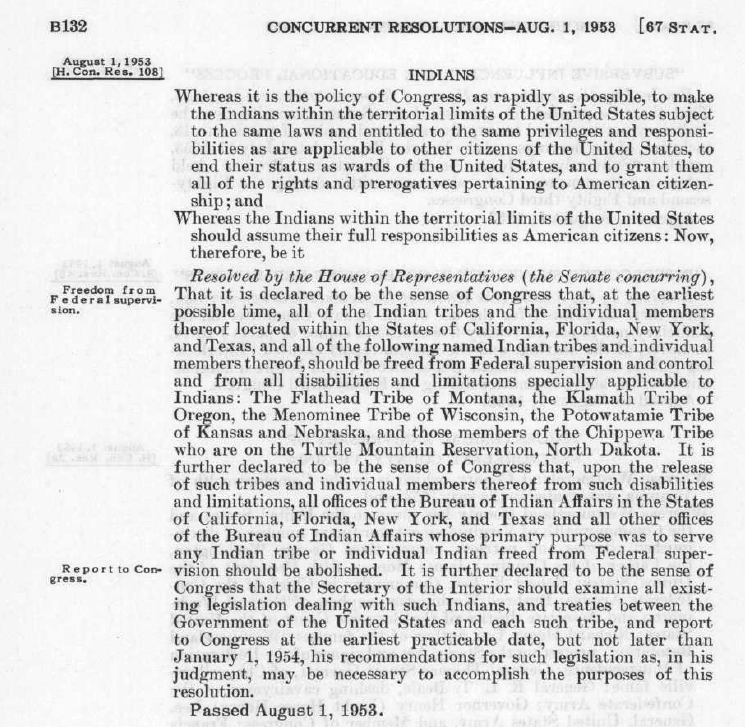
This document was yet another moment of the United States government causing harm to already marginalized, oppressed people. This act was put into effect during the timeline of our book, but Regina also speaks briefly about events that transpired before this story. Regina says of her school "Sometimes Budlong Elementary felt like the boarding school that Chich's mother had gone to long ago" (McManis 132).
Boarding schools had cruel policies that were intended to cause cultural erasure. At boarding schools, "reformers separated children as young as five from their parents and grandparents and made them take new names and wear strange clothes. They forbade them from speaking their own languages or practicing their own religions" (Duval 514). Thankfully, despite this, Chich was still able to speak her native language and many of the people in her tribe still knew their family's songs and dances.